Can a 12x27x4 Air Filter Help Someone With COPD Breathe Better at Home?
After manufacturing filters for over a decade and hearing directly from customers managing COPD, we've learned something most filter companies won't tell you: MERV rating alone doesn't determine how well a filter protects compromised lungs.
Fit, airflow resistance, and change frequency matter just as much — sometimes more. The 12x27x4 air filters can meaningfully reduce the indoor triggers that make COPD symptoms worse. But based on what we've seen across millions of customer interactions, the difference between a filter that helps and one that barely moves the needle comes down to a few specific decisions most people don't know to make. This page breaks down exactly what those decisions are — and how to make them confidently for your home.
Quick Answers
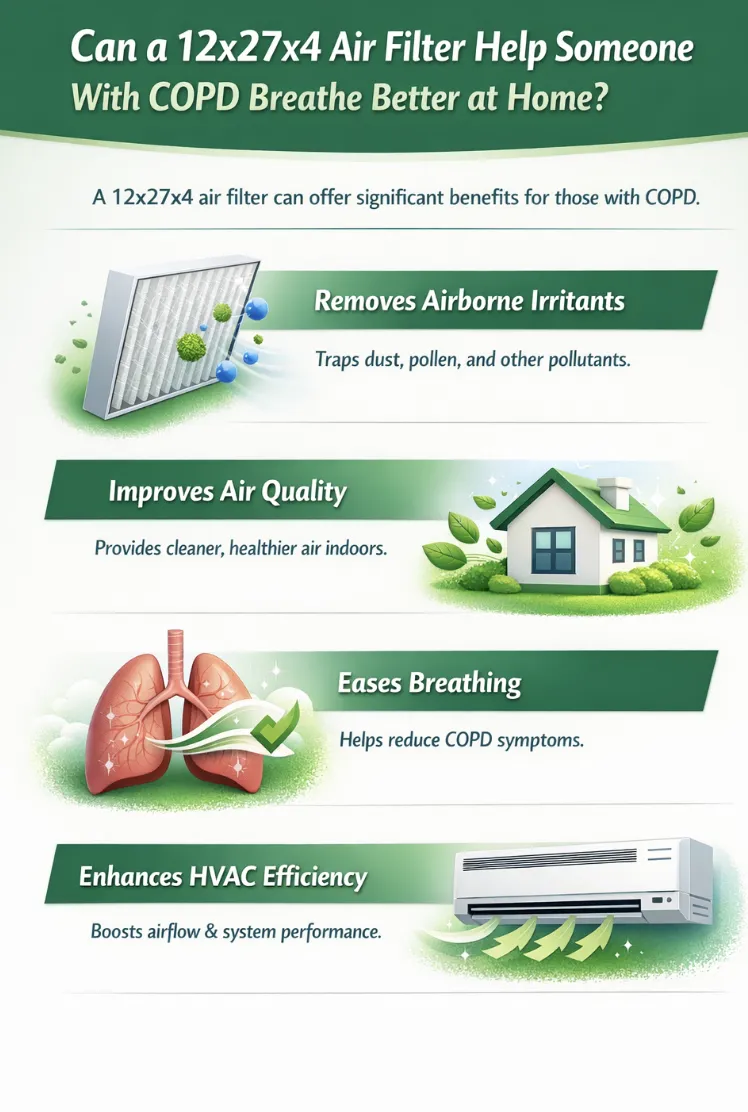
Can a 12x27x4 Air Filter Help Someone With COPD Breathe Better at Home? Yes — when selected and maintained correctly, a 12x27x4 air filter can meaningfully reduce the indoor airborne triggers that make COPD symptoms worse.
Here is what makes the difference:
Right MERV rating: MERV 11 at minimum. MERV 13 for more severe conditions or poor outdoor air quality.
Proper fit: No gaps around the filter housing — unfiltered air bypassing the media defeats the purpose entirely.
Consistent changes: Check every 60 to 90 days. Replace before efficiency drops — not after.
Four-inch advantage: More filtration media, longer effective lifespan, and better sustained particle capture than a one-inch filter.
What it captures: Dust, mold spores, pet dander, pollen, dust mite debris, and fine particulate matter smaller than 2.5 microns — the particle categories most likely to trigger COPD flare-ups indoors.
What it cannot do: Replace prescribed COPD therapies or eliminate gases and volatile organic compounds without additional air purification.
Bottom line: A properly rated, correctly seated, regularly changed 12x27x4 filter is one of the most practical and continuously available tools for protecting the air a compromised respiratory system depends on every day. It is not a cure. Used consistently, it is a meaningful and immediate line of defense.
Top Takeaways
MERV rating is the starting point — not the whole answer.
MERV 11 is the minimum for COPD households.
MERV 13 is worth considering for homes with poor outdoor air quality or prior smoke exposure.
Fit, airflow compatibility, and change frequency determine whether the rating delivers.
The four-inch depth of a 12x27x4 filter is a meaningful advantage.
More filtration media than a one-inch filter.
Longer effective lifespan between changes.
Fewer gaps in protection — critical in a respiratory-sensitive household.
A filter past its effective lifespan isn't protecting anyone.
Check the filter every 60 to 90 days in a COPD household.
Replace before it reaches full capacity.
A heavily loaded filter can release particles rather than capture them.
Consistency beats specification every time.
The best filter is the one changed on schedule.
A fresh MERV 11 outperforms an overdue MERV 13.
Reliable change habits matter more than MERV rating alone.
Mechanical filtration is one tool in a larger strategy.
Addresses the largest category of indoor respiratory triggers continuously.
Does not replace prescribed COPD therapies or physician guidance.
Used consistently, it creates a measurably cleaner breathing environment where every breath counts.
How COPD Changes the Way You Need to Think About Indoor Air
Living with COPD means your lungs are working harder than they should just to do their job. Outdoor air gets most of the attention, but indoor air quality is where you spend the majority of your time — and where your filter does its most important work. Dust, pet dander, mold spores, and fine particulate matter don't just cause discomfort for someone with COPD. They trigger inflammation, accelerate exacerbations, and make breathing measurably harder.
What a 12x27x4 Air Filter Actually Does Inside Your HVAC System
Your HVAC system cycles your home's air continuously. Every pass through the system is an opportunity to capture the particles that irritate lung tissue. A 12x27x4 filter sits in that pathway and acts as the primary line of defense. The four-inch depth is a significant advantage — thicker filters hold more filtration media, capture more particles per pass, and typically last longer between changes, which means fewer gaps in protection.
Why MERV Rating Matters More When Respiratory Health Is on the Line
MERV ratings measure how effectively a filter captures particles across different size ranges. For COPD management, MERV 11 is generally the practical starting point. It captures fine dust, mold spores, and pet dander that lower-rated filters miss entirely.
MERV 13 captures even finer particles — including some bacteria and smoke — and is worth considering for households where outdoor air quality is frequently poor or where a smoker was previously in the home. MERV 8 filters, while adequate for general use, do not provide meaningful protection for compromised respiratory systems.
The Particles a Good Filter Should Be Stopping
Not all airborne particles carry the same risk for COPD sufferers. The ones that matter most are fine particulate matter smaller than 2.5 microns, mold spores, dust mite debris, pet dander, pollen, and tobacco smoke residue. A properly rated 12x27x4 filter captures the majority of these on every air cycle. What it cannot address on its own is volatile organic compounds and gases — those require additional air purification beyond standard filtration.
Filter Fit and Airflow: The Two Factors Most People Overlook
A filter that doesn't seat properly in its housing is almost no filter at all. Unfiltered air bypasses the media entirely through gaps at the edges and circulates straight back into your living space. For COPD sufferers, that bypass represents real exposure risk. Equally important is airflow resistance. A filter that is too restrictive for your system can reduce airflow to the point where your HVAC struggles — and a struggling system distributes air less effectively throughout your home.
How Often to Change a 12x27x4 Filter When Someone Has COPD
Standard filter change guidance doesn't apply the same way in a home where respiratory health is a priority. Four-inch filters typically carry a 6-to-12-month lifespan under normal conditions. In a home with a COPD sufferer, checking the filter every 60 to 90 days is a better practice — and changing it before it reaches full capacity ensures consistent filtration performance. A heavily loaded filter loses efficiency and can become a source of particulate release rather than capture.
What a Filter Can and Cannot Do for COPD Management
A 12x27x4 air filter is one of the most accessible and cost-effective tools for improving indoor air quality in a home where someone has COPD. It works continuously, requires no active management beyond regular changes, and addresses the single largest category of indoor respiratory triggers. It is not a medical treatment and does not replace prescribed therapies or physician guidance.
Used consistently and correctly, however, it creates a measurably cleaner breathing environment — and for someone managing a chronic respiratory condition, that matters every single day.
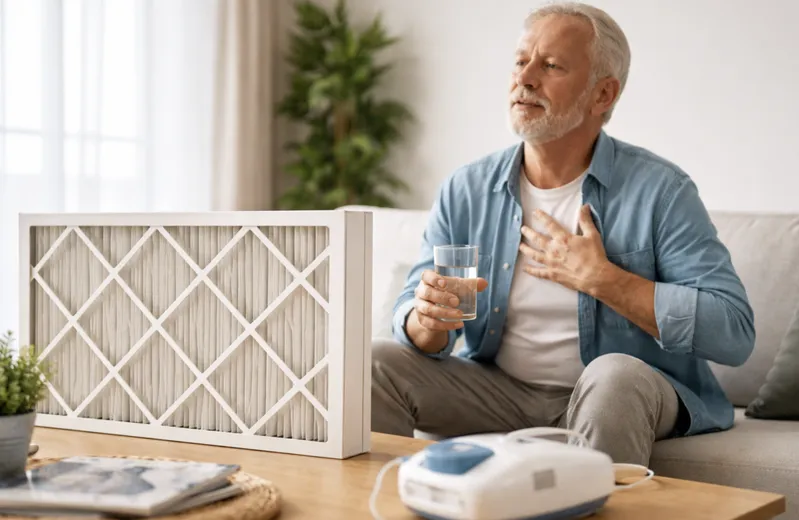
"In our experience manufacturing filters and working directly with customers managing COPD, the homes that see the greatest improvement in indoor air quality aren't necessarily running the highest-rated filter — they're running the right-rated filter, changed on schedule, seated without gaps, in a system that can actually move air efficiently through it."
Essential Resources on Can a 12x27x4 Air Filter Help Someone With COPD Breathe Better at Home?
When someone in your home is managing COPD, you shouldn't have to guess at what the right filter decision looks like. We've pulled together the seven most valuable resources available so you can move from uncertainty to confidence — fast. These are the sources we trust, the ones backed by real science and institutional authority, and the ones we point to when our own customers need answers beyond what a filter label can tell them.
American Lung Association — COPD Overview and Air Quality Guidance
The ALA is the definitive starting point for understanding how indoor air quality directly affects COPD symptoms and progression. If you're trying to connect filtration decisions to real respiratory outcomes, this is where to begin. www.lung.org/lung-health-diseases/lung-disease-lookup/copd
EPA — Indoor Air Quality and Health
The EPA breaks down exactly which indoor pollutants pose the greatest risk and how mechanical filtration reduces your exposure to them. Essential reading for any household prioritizing respiratory health. www.epa.gov/indoor-air-quality-iaq
EPA — Understanding MERV Ratings
Before you choose a filter, you need to understand what MERV ratings actually measure and what they mean for particle capture at the sizes that matter most for compromised lungs. The EPA explains it clearly and without the marketing language. www.epa.gov/indoor-air-quality-iaq/what-merv-rating
NHLBI — Living With COPD
The National Heart, Lung, and Blood Institute provides patient-focused guidance on managing COPD triggers inside the home — including air quality recommendations that translate directly into practical filter decisions. www.nhlbi.nih.gov/health/copd/living-with
CDC — COPD and Environmental Triggers
The CDC identifies the specific environmental factors that accelerate COPD exacerbations and outlines the steps proven to reduce exposure. A critical resource for building a whole-home air quality strategy around a loved one's diagnosis. www.cdc.gov/copd
ASHRAE — Filtration and Air Cleaning Standards
ASHRAE sets the industry standards that MERV ratings are built on. If you want to understand the engineering behind filter performance — and why a four-inch filter outperforms a one-inch in sustained particle capture — this is the authoritative source. www.ashrae.org/technical-resources/filtration-and-air-cleaning
FilterBuy — 12x27x4 Air Filters
We manufacture our 12x27x4 filters in multiple MERV ratings precisely because different households have different needs — and a home managing COPD has needs that a standard filter recommendation won't address. Browse our full selection, compare specifications, and find the right fit for your system and your family. www.filterbuy.com/filters/air-filters/12x27x4/
Supporting Statistics
After more than a decade of manufacturing air filters and working directly with customers managing serious respiratory conditions, we've learned that the data on indoor air quality and COPD reflects the daily reality of the people who call us looking for answers.
More than 16 million Americans Are Currently Living With a COPD Diagnosis
The CDC confirms that more than 15 million U.S. adults have received a COPD diagnosis — and many more are living with the condition without knowing it. We hear from a significant number of those households every year. What they share in common:
A diagnosis that makes indoor air quality a daily priority
The realization that home air is either helping or hurting their condition
The need for an immediate, accessible intervention — no prescription required
A properly rated, correctly seated, regularly changed filter is one of the few steps they can take right now.
Indoor Air Pollutant Concentrations Are Often 2 to 5 Times Higher Than Outdoor Levels
The EPA reports that Americans spend approximately 90 percent of their time indoors, where concentrations of some pollutants are often 2 to 5 times higher than typical outdoor concentrations — and that people most susceptible to the adverse effects of pollution, including those with respiratory disease, tend to spend even more time indoors.
This is the statistic that surprises our customers most. Here's what it means in practical terms:
Most people assume outdoor air is the greater threat
For COPD households, the air cycling through your HVAC system is the air your lungs process most
The filter sitting in your system right now is your primary line of defense against that exposure
Federal Researchers Are Actively Studying Home Air Filters as a Direct COPD Intervention
The NHLBI notes that patients with COPD who breathe poor quality air at home may risk worse symptoms, and that NHLBI-funded researchers are currently testing home air filter use to reduce indoor pollutants — with the specific goal of determining whether filters can reduce flare-ups and medication use.
We've communicated this to customers for years based on what we've observed. Three things this research confirms:
Filter quality matters clinically — not just for comfort
Change frequency directly affects protection levels
The link between home filtration and COPD outcomes is significant enough for the nation's leading lung health institution to fund dedicated research around it
What COPD households have been telling us from their own experience for years, federal science is now working to formally validate.
Final Thoughts
A 12x27x4 air filter won't cure COPD. We want to be straightforward about that because you deserve honesty over a sales pitch.
What the right filter can do:
Reduce the concentration of airborne particles that make breathing harder.
Provide continuous, passive protection without a prescription.
Create a measurably cleaner breathing environment for a compromised respiratory system.
After more than a decade of manufacturing filters and hearing directly from COPD households, our perspective is grounded in a specific observation. The households reporting the most noticeable air quality improvement aren't always running the highest-rated filter available. They share three things in common: a deliberate, informed filter selection, a consistent change schedule, and a realistic understanding of what filtration can address.
That last point leads to what we consider the most underappreciated truth in filter selection for respiratory-sensitive households: Consistency beats specification every time. A MERV 13 filter four months past its effective lifespan isn't protecting anyone the way a fresh MERV 11 changed on schedule would.
The 12x27x4 format gives you a real advantage:
More filtration media than a one-inch filter.
Longer effective lifespan between changes.
Better sustained particle capture over time.
For a household managing COPD, a well-chosen, well-maintained 12x27x4 filter isn't a minor comfort upgrade. It's one of the most practical, consistently available tools for protecting the air a compromised respiratory system depends on every single day.
Frequently Asked Questions
Q: Can a 12x27x4 air filter actually make a difference for someone with COPD? A: Yes — based on more than a decade of manufacturing filters and working directly with COPD households. Three conditions must be met: the right MERV rating, a proper seal with no gaps, and a change schedule that stays ahead of efficiency loss.
Q: What MERV rating should someone with COPD look for in a 12x27x4 air filter?
A: Based on direct feedback from millions of customers, here is our honest guidance:
MERV 11 — the practical starting point for every COPD household.
MERV 13 — worth considering when outdoor air quality is poor, a smoker previously lived in the home, or symptoms are severe.
MERV 8 — adequate for standard households but insufficient for compromised respiratory systems.
One thing we always tell customers before upgrading: confirm your HVAC system can handle the increased airflow resistance.
Q: How often should a 12x27x4 air filter be changed in a home where someone has COPD? A: More often than the packaging suggests. We recommend checking the filter every 60 to 90 days and replacing it before it reaches full capacity. In a COPD household, getting extra weeks out of an overloaded filter is never worth the exposure risk.
Q: What airborne particles does a 12x27x4 filter target that are most relevant to COPD? A: A properly rated filter intercepts fine particulate matter (< 2.5 microns), mold spores, dust mite debris, pet dander, pollen, and tobacco smoke residue. It cannot address volatile organic compounds or gases on its own.
Q: Is a 12x27x4 air filter enough on its own to improve indoor air quality for a COPD household? A: It is the most important foundational step — but not a standalone fix. It works best alongside regular HVAC maintenance, humidity control, and reducing indoor particulate sources like candles or harsh chemical cleaners.
Ready to Find the Right 12x27x4 Air Filter for a COPD Household?
Browse FilterBuy's full selection of 12x27x4 air filters in MERV 11 and MERV 13 — engineered for households where air quality isn't a preference, it's a priority. Find your filter today and take the most practical step available toward cleaner, safer air for the lungs that depend on it most.
Learn more about HVAC Care from one of our HVAC solutions branches…
Filterbuy HVAC Solutions - Miami FL - Air Conditioning Service
1300 S Miami Ave Apt 4806 Miami FL 33130
(305) 306-5027
https://maps.app.goo.gl/Ci1vrL596LhvXKU79
Meta description:
The right 12x27x4 filter can reduce COPD triggers hiding in your air. See what MERV rating actually helps. Click here for expert guidance.